EARTH
A Sustainable Approach to Architecture

Earth building is one of the oldest and most sustainable construction techniques in the world, using natural materials like soil, clay, sand, and sometimes lime to create structures. Long before modern cement and steel, civilizations across Africa, the Middle East, Asia, and South America relied on earth to build homes, temples, and even entire cities—many of which still stand today.
At its core, earth building is about working with nature rather than against it. The soil used is typically a mix of clay (which binds), sand (which gives strength), and sometimes gravel. Depending on the method, this mixture can be shaped, compressed, or layered to form walls and structural elements.
Common Earth Building Techniques
-
Adobe: Sun-dried bricks made from mud and straw.
-
Rammed Earth: Damp soil compacted into formwork to create dense, strong walls.
-
Cob: A hand-sculpted mix of clay, sand, and straw, allowing for organic forms.
-
Compressed Stabilized Earth Blocks (CSEB): Machine-pressed blocks, often stabilized with lime or a small amount of cement.
-
Wattle and Daub: A woven framework filled with a mud mixture.
-
Shuttered debris wall : Mixed rubble and earth compacted within temporary formwork to create a solid, monolithic wall.

Rammed earth wall

Shuttered debris wall

Cobb wall
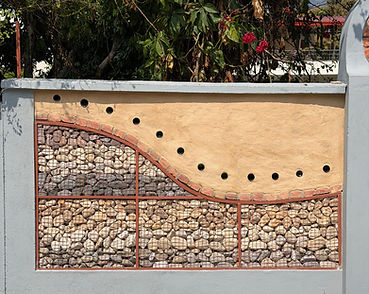
Cobb wall & Gabian wall
Why Earth Building Matters Today
With growing awareness around climate change and sustainable architecture, earth construction is gaining renewed interest. Compared to conventional materials like concrete, it has:
-
Low embodied energy (minimal processing required)
-
Excellent thermal performance (keeps interiors cool in summer and warm in winter)
-
Breathability (helps regulate indoor humidity)
-
Local availability (reduces transportation costs and environmental impact)


